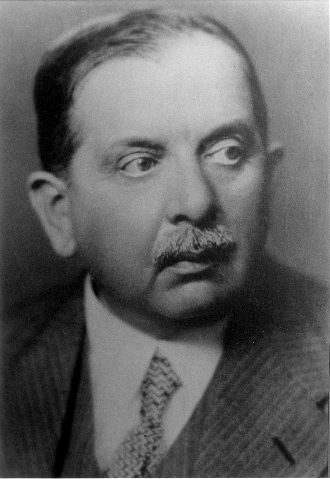
Egon Ranzi
Egon Ranzi was born on March 3, 1875, in Vienna, where he also studied and earned his medical doctorate. Like von Haberer and later Breitner, he first joined the renowned surgeon Eiselsberg in Vienna, working there from 1902 to 1919. He habilitated in 1909 and, three years later, became associate professor and head of the First Surgical Department of the Rudolfsstiftung in Vienna.
In 1924 he received the call to Innsbruck as Ordinarius, remaining for 12 years and leaving the city only when he was able to become Eiselsberg’s successor in Vienna.
As delighted as he was to succeed his revered teacher, he often longed for Innsbruck—according to Professor Huber’s obituary—describing the 12 years he spent there as the happiest of his life. Huber noted that Ranzi was not well equipped for the competitive environment of a large metropolis, lacking entirely the talent for self‑promotion.
His time in Vienna was brief. In 1938, at the age of 64, he was forced into retirement by the political authorities, and he died a year later of a renal disease.
Ranzi devoted much of his work to the challenges of abdominal surgery, especially the surgery of the spleen, liver, and pancreas. He promoted advances in thoracic and vascular surgery and was also interested in spinal cord diseases. Together with Tandler, he published an anatomy of the central nervous system.
Particularly remarkable is that he was already conducting experimental cancer research, well ahead of his time.
Professor Huber—himself a student of Ranzi during his training in Innsbruck—wrote in his obituary:
“We all think with gratitude of the certainly strict, yet benevolent, kind‑hearted and fair‑spirited school through which we passed under him.”