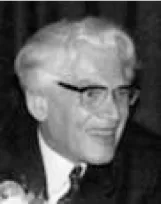
Paul Huber
Paul Huber, who served as head of the Surgical University Clinic of Innsbruck from 1956 to 1971, died on December 30, 1975.
He received his doctorate from the University of Innsbruck on February 28, 1925. His professional training in surgery began at the Institute of Pathological Anatomy at the University of Vienna under Professor Maresch, followed by training at the Fourth Medical Department of the Vienna General Hospital under Hofrat Kovács. On January 1, 1927, he became an assistant at the Surgical University Clinic in Innsbruck under Professor Ranzi. In 1928, he was delegated for one year to the German Hospital in London (Chief Physician Dr. Rast). He then continued his surgical training once again at the Innsbruck Surgical Clinic until the summer of 1932. In the autumn of 1932, he followed his teacher, Professor Ranzi—who had been appointed head of the First Surgical University Clinic in Vienna—and joined him there as assistant.
In 1937, Huber completed his habilitation in surgery. After Professor Ranzi’s departure in 1938, Huber remained at the clinic as assistant under Professor Schönbauer until the end of the war. In May 1945, he was appointed head of the Surgical Department of the Kaiserin Elisabeth Hospital in Vienna. Later that same year, the Vienna Medical Faculty awarded him the title of Associate Professor.
In 1956, Huber was appointed successor to Professor Breitner as head of the Surgical University Clinic Innsbruck. With his assumption of the chair, he faced the essential task of initiating, advancing, and completing the construction of the new surgical university clinic. At the same time, he had to fulfill the duties associated with the office of clinic director—those of physician, scientist, and teacher. Those who knew Huber were aware that he carried out all these responsibilities with the utmost conscientiousness.
The opening of the new surgical clinic—the largest in Austria—in December 1968 represented the crowning achievement of his professional life.
Continuing in the spirit of Breitner, Huber had already begun in earlier years to subdivide the field of surgery by creating independent specialist departments in the form of separate chairs. During his tenure, the first such independent institute in Europe—Anesthesiology—was established.
It was followed—listed here alphabetically—by new chairs for Geriatric Surgery, Neurosurgery, Nuclear Medicine, Orthopedics, Plastic and Reconstructive Surgery, Trauma Surgery, and Urology. With these steps, he charted new paths for the German‑speaking academic world. He was convinced that only the professional recognition conferred by establishing independent chairs could ensure the necessary development of the surgical subspecialties. At the same time, he always regarded the internal cohesion of all these disciplines as essential and preserved it throughout his career.
from Acta Chirurgica Austriaca, “Prof. Dr. Paul Huber zum Gedenken”