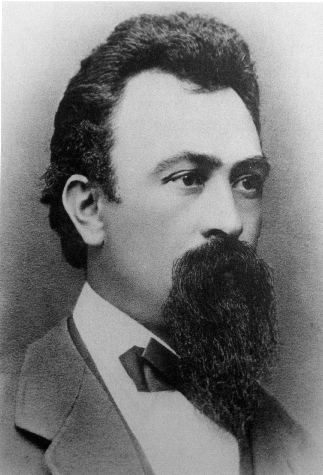
Eduard Albert
Eduard Albert was born on January 20, 1841, as the son of a watchmaker in Senftenberg near Königgrätz (Hradec Králové in eastern Bohemia). He studied in Vienna, received his doctorate at the age of 25 (January 22, 1867), obtained his surgical training under Johann Freiherr von Dumreicher (1815–1880), and completed his habilitation five years later (1872).
Only one year afterward, he was offered the directorship of the surgical clinic in Liège. However, his former teacher Carl von Rokitansky—at that time working in the ministry—ensured that, after the departure of Karl Heine to Prague, Albert was appointed to the professorship in Innsbruck (July 23, 1873). Today one might say that he prevented a “brain drain” abroad.
Albert worked in Innsbruck for eight years. His specialty was orthopedics, and he was the first in the Austro‑Hungarian Monarchy—and the second in Europe—to introduce Listerian principles of preventing and treating suppurative surgical wounds. Carbolic acid and later sublimation (a mercury compound), which impaired his health, were used in these antiseptic methods—the first successful operation took place on October 27, 1875.
Albert was a highly innovative surgeon. He performed the first nephrectomy in Austria‑Hungary in 1876; resections of the upper and lower jaw; procedures for arthrosis of the shoulder and elbow joints; and operations for uterine tumors followed. He established small‑intestine resection, and the three‑row intestinal suture is named after him. During his time in Innsbruck, he produced a four‑volume textbook of surgery and a work on the diagnostics of surgical diseases, which was reissued as recently as 2010*. His students Julius Hochenegg and Erwin Payr later revised these textbooks. In 1881, he became full professor and head of the First Surgical University Clinic in Vienna.
Although his passion belonged to orthopedics—and he is regarded as the founder of Austrian orthopedics (the term Achillodynia, describing a degenerative condition of the Achilles tendon and its insertion, goes back to him)—his interests were nevertheless wide‑ranging.
He attempted the first nerve transplantation. The earliest blood pressure measurement experiments with a so‑called kymographion are also credited to him. He died in 1900—only 59 years old—in Vienna and was laid to rest in an honorary grave. His student Adolf Lorenz continued his orthopedic‑surgical tradition and became the “father of orthopedics,” with his method of modeling redressment for clubfoot, and with the reduction and conservative treatment of congenital hip dislocation—methods that replaced the previously bloody procedures worldwide.
Die Wiener Medizinische Schule, 449-454 u. Tragl Karl Heinz: Chronik, 69f
*Diagnostik Der Chirurgischen Krankheiten; Herausgeber : Nabu Press (22. Februar 2010) ISBN-10 : 1145034780; ISBN-13 : 978-1145034785
Lehrbuch der Chirurgie und Operationslehre; Herausgeber : Salzwasser-Verlag GmbH; Illustrated Edition (9. Juli 2013) ISBN-10 : 3846042277, ISBN-13 : 978-3846042274